

Ready to Grow? Key Factors to Consider Before Expanding Your Urgent Care Operation
Explore the key factors urgent care operators should evaluate before expanding, including market demand, staffing, financial readiness, technology, credentialing, leadership,


Ready to Grow? Key Factors to Consider Before Expanding Your Urgent Care Operations
Growth is often viewed as a sign of success—and it can be. Adding locations, expanding hours, introducing new services, or entering new markets can increase revenue and strengthen your organization’s presence. However, growth can also expose operational weaknesses that were manageable at one location but become costly at scale.
Before expanding, urgent care operators should determine whether the organization is truly prepared to support additional volume, complexity, and financial risk.
1. Define What Growth Means for Your Organization
Expansion does not always mean opening another location. Growth may include:
- Extending operating hours
- Adding occupational medicine or employer services
- Introducing primary care, telehealth, weight management, or other service lines
- Expanding laboratory or imaging capabilities
- Acquiring an existing practice
- Entering a neighboring community
- Opening additional urgent care locations
Each strategy carries different staffing, compliance, technology, and financial requirements. Leadership should first establish what it hopes to accomplish and how success will be measured.
Is the goal to increase patient volume, improve market coverage, diversify revenue, strengthen payer relationships, or create economies of scale? A clearly defined objective helps prevent expansion from becoming growth for growth’s sake.
2. Confirm That Current Operations Are Stable
A new location will rarely solve problems within an existing operation. In many cases, it magnifies them.
Before expanding, assess the performance of your current sites:
- Are patient wait times acceptable?
- Are staffing levels dependable?
- Is provider productivity consistent?
- Are charts being completed promptly?
- Are claims being submitted accurately and without unnecessary delays?
- Are denials and aging accounts receivable being actively managed?
- Are policies and workflows standardized?
- Can managers explain and reproduce the processes that are working?
If a practice relies heavily on one experienced employee, extensive workarounds, or constant leadership intervention, it may not yet have an operating model that can be replicated successfully.
The goal is not perfection. The goal is to ensure that your core processes are stable, documented, measurable, and scalable.
3. Evaluate the Market Carefully
A growing community does not automatically guarantee a successful urgent care center. Market analysis should extend beyond population counts and traffic patterns.
Consider:
- Population growth and demographics
- Existing urgent care, retail clinic, emergency department, and primary care competition
- Local payer mix
- Employer concentration
- Occupational medicine opportunities
- Seasonal demand
- Average household income
- Visibility and ease of access
- Parking availability
- Community awareness of urgent care
- Potential referral relationships
- Current provider shortages
Operators should also evaluate how competitors are positioned. A market may appear crowded but still have an unmet need for extended hours, pediatric care, occupational health, better patient access, or a more efficient experience.
The strongest expansion opportunities solve a specific community problem rather than simply placing another clinic on the map.
4. Build a Realistic Financial Model
Expansion requires more than estimating rent, equipment, and salaries. A sound financial model should account for both the cost of opening and the time required to reach sustainable patient volume.
Important projections include:
- Construction and facility costs
- Medical equipment and supplies
- Technology implementation
- Licensing, legal, and professional fees
- Marketing expenses
- Recruiting and training costs
- Credentialing timelines
- Initial payroll
- Working capital
- Expected payer mix
- Average reimbursement per visit
- Break-even visit volume
- Claim submission and payment delays
- Seasonal fluctuations
A location may be operationally ready to see patients but still unable to bill certain payers if credentialing is incomplete. This can create a significant cash-flow gap during the first several months.
Financial planning should include conservative, expected, and optimistic scenarios. If the project only works under the most favorable assumptions, the strategy deserves another look.
5. Assess Leadership Capacity
Every additional location increases the need for clear accountability.
Before expanding, ask whether the organization has leaders who can manage daily operations without requiring constant direction from the owner or executive team. A strong leadership bench may include:
- An experienced clinic manager
- Clinical leadership or established delegation of duties
- Revenue cycle oversight
- Human resources support
- Compliance expertise
- Training and onboarding resources
- Centralized operational leadership
Founders and senior leaders often carry a great deal of institutional knowledge. If that knowledge has not been translated into policies, training materials, performance standards, and repeatable workflows, expansion may place too much pressure on a small number of people.
A scalable operation should not depend on the physical presence of one individual to function properly.
6. Determine Whether You Can Recruit and Retain the Right Team
Workforce availability can determine whether an expansion succeeds or struggles.
Operators should evaluate the local supply of physicians, advanced practice providers, clinical support staff, radiology personnel, and front-office employees. Compensation expectations, scheduling models, benefits, supervision requirements, and state scope-of-practice rules should all be considered.
Recruitment is only part of the equation. New employees need a consistent onboarding process that clearly addresses:
- Clinical expectations
- Documentation standards
- Coding awareness
- Patient experience
- Safety protocols
- Escalation procedures
- Technology use
- Productivity expectations
- Organizational culture
Rapid growth without standardized onboarding can lead to inconsistent care, documentation gaps, employee frustration, and revenue leakage.
7. Make Sure Your Technology Can Scale
Technology should make expansion easier—not create additional administrative layers.
Your electronic medical record, practice management system, patient intake process, reporting tools, and revenue cycle workflows should support multi-location operations. Leadership should be able to view performance across the organization while also drilling down to individual locations, providers, and service lines.
Key capabilities may include:
- Centralized scheduling and registration
- Multi-site visibility
- Standardized charting templates
- Real-time eligibility verification
- Integrated patient payments
- Provider productivity reporting
- Denial and accounts-receivable tracking
- Role-based access
- Centralized task management
- Consistent patient communication
- Actionable business intelligence
If the organization must add manual spreadsheets, duplicate data entry, or disconnected systems every time it adds a location, technology may eventually become a barrier to growth.
8. Plan for Credentialing, Contracting, and Compliance Early
Credentialing and payer enrollment are frequently underestimated during expansion. Depending on the payer and market, enrollment can take several months.
Operators should determine:
- Whether the new location requires separate payer enrollment
- Which providers must be added or revalidated
- Whether contracts apply to the new service area
- Whether the new location will operate under an existing or new tax identification number
- Which state and local licenses are required
- Whether CLIA, imaging, pharmacy, laboratory, or occupational health requirements apply
- Whether supervision or collaboration agreements are necessary
These activities should begin early and be incorporated into the project timeline. Opening before credentialing is complete may limit scheduling, delay billing, or result in out-of-network claims.
9. Standardize the Patient Experience
Patients should receive a consistent experience regardless of which location they visit.
Standardization should address:
- Scheduling and registration
- Check-in and intake
- Triage
- Clinical workflows
- Discharge instructions
- Follow-up communication
- Patient payment collection
- Complaint resolution
- Referral management
Consistency builds trust and makes performance easier to measure. At the same time, each location may require some flexibility based on community needs, patient demographics, or employer relationships.
The objective is to maintain a recognizable organizational standard while allowing appropriate local adaptation.
10. Establish Performance Metrics Before Opening
Do not wait until after expansion to decide how success will be evaluated.
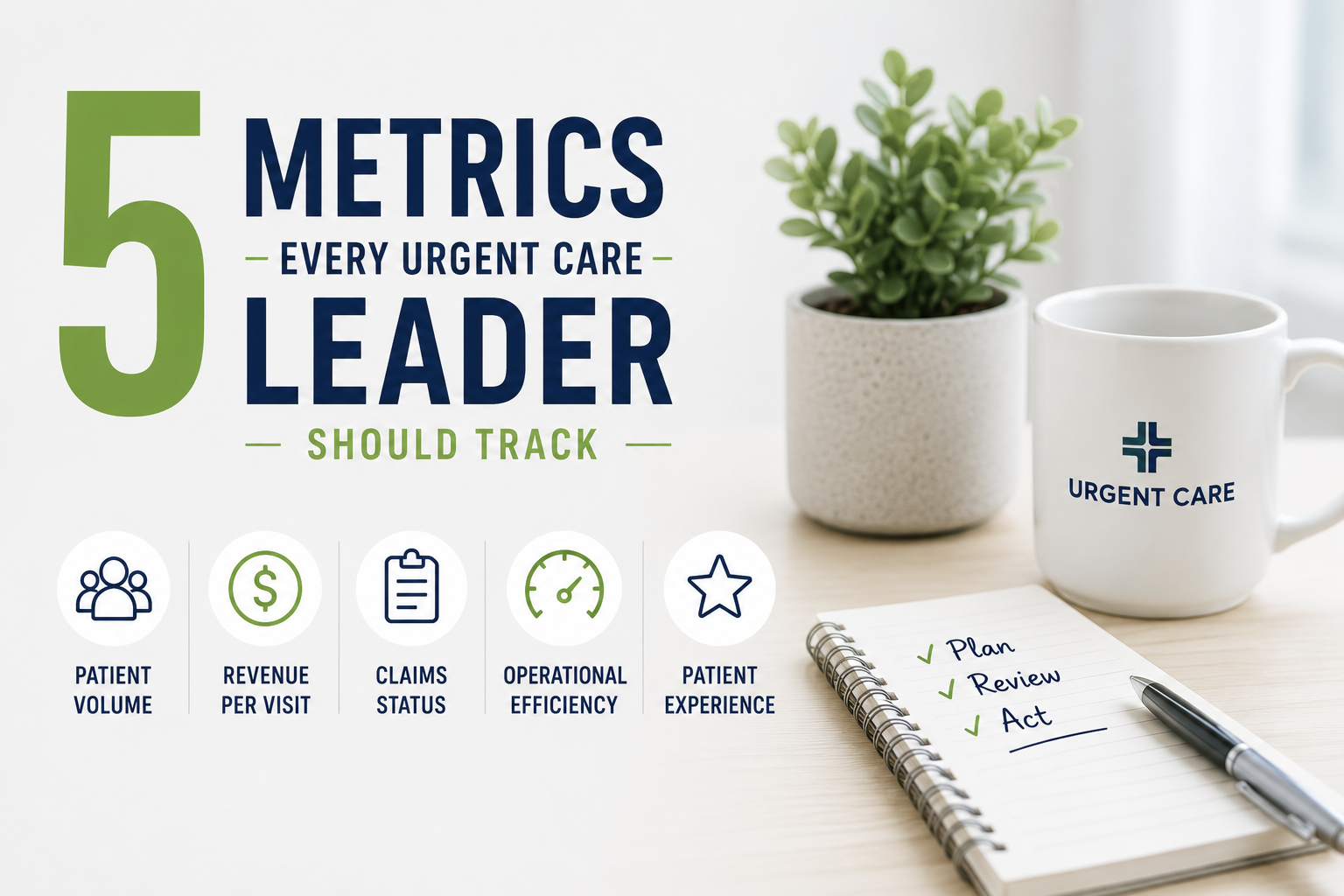
Leadership should identify a focused set of operational, clinical, and financial indicators, such as:
- Daily visit volume
- Door-to-discharge time
- Provider productivity
- Patient satisfaction
- Labor cost per visit
- Net revenue per visit
- Point-of-service collections
- Days to charge entry
- Clean-claim rate
- Denial rate
- Days in accounts receivable
- Chart completion time
- Employee turnover
Early monitoring allows leadership to recognize patterns and intervene before small issues become entrenched operational problems.
Growth Should Strengthen the Organization
The right expansion can create new opportunities for patients, employees, and owners. The wrong expansion—or the right expansion undertaken too quickly—can strain cash flow, dilute culture, and distract leadership from the organization’s core business.
Before moving forward, urgent care operators should ask one central question:
Have we built an operation that is ready to be replicated, or are we hoping expansion will fix what is not yet working?
Sustainable growth is built on disciplined planning, stable operations, capable leadership, scalable technology, and reliable revenue cycle performance. When those foundations are in place, expansion becomes more than an opportunity to become larger—it becomes an opportunity to become stronger.
If you are preparing to expand your urgent care organization, selecting technology and revenue cycle partners that can support multiple locations, standardized workflows, and actionable reporting should be part of the strategy from the beginning. UrgentIQ helps urgent care operators build a scalable infrastructure designed to support efficient operations and long-term growth.
For more information on how UrgentIQ can assist in the planning, growth, and success of your urgent care- email sales@urgentiq.com

More blog posts to read


Prefer to send an email? Send us your request at sales@urgentiq.com, and we'll coordinate with you directly.
