

The Hidden Revenue Drain: How Commercial Payers Are Downcoding More Claims
Commercial payers are increasing claim denials and E&M downcoding. Learn how urgent care operators can protect revenue.

Why Commercial Payers Are Downcoding More Claims in 2026 — And What Urgent Care Operators Can Do About It
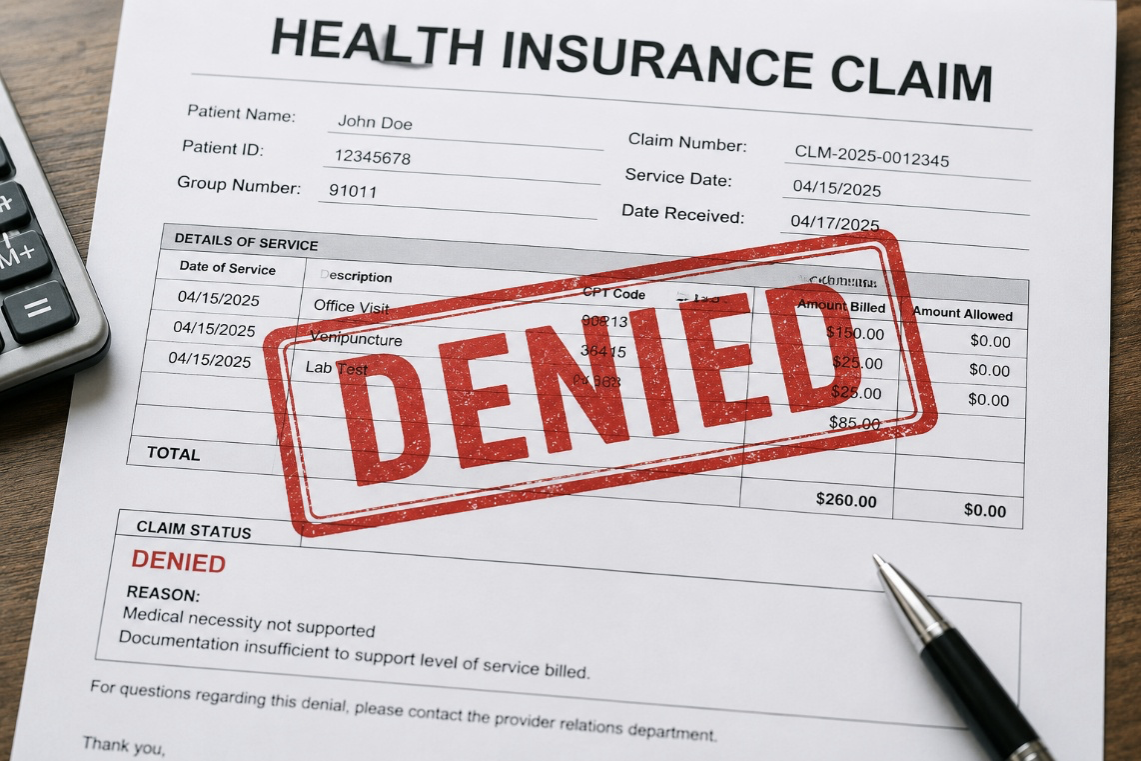
Across the country, urgent care operators are reporting a common concern: claims that were routinely reimbursed at higher levels are increasingly being downcoded or denied by commercial insurers.
Whether it appears as a reduction in Evaluation and Management (E&M) levels, requests for additional documentation, medical necessity denials, or reimbursement reductions after adjudication, many organizations are experiencing growing pressure on revenue. Industry reports indicate denial activity continues to rise, while payers are leveraging increasingly sophisticated analytics and automated review systems to identify claims for further scrutiny.
Why Are Payers Increasing Downcoding Activity?
Several factors are driving this trend.
1. Increased Use of Automated Claim Review Technology
Commercial insurers are investing heavily in predictive analytics and artificial intelligence to review claims before payment. Rather than evaluating claims individually, many systems now analyze billing patterns across entire provider groups and compare them against payer benchmarks. Claims with patterns that differ from expected norms may be flagged for review, downcoding, or denial.
For urgent care centers, this often means higher-level E&M services, frequent modifier usage, or unusually consistent coding patterns may receive additional scrutiny.
2. Rising Pressure to Control Healthcare Costs
Commercial payers continue to face pressure from employers, regulators, and shareholders to contain healthcare spending. One of the most effective ways to reduce expenditures is through more aggressive claims management strategies, including increased documentation requirements, medical necessity reviews, and reimbursement audits.
While payers rarely characterize these efforts as downcoding initiatives, many providers are seeing the financial impact.
3. Greater Focus on E&M Services
Evaluation and Management services remain one of the largest areas of reimbursement for urgent care organizations. Recent payer activity has focused heavily on validating whether documentation supports the billed level of service.
Some industry observers have reported increased automated E&M downcoding programs among major insurers, particularly for office and outpatient services.
4. Expansion of Data-Driven Auditing
Payers are increasingly comparing providers against peer groups and specialty benchmarks. Organizations with coding distributions that differ significantly from regional or national norms may be targeted for additional review.
This doesn't necessarily mean the coding is incorrect—but it often means providers must be prepared to defend it.
How This Impacts Urgent Care Centers
Even small reimbursement reductions can create significant financial consequences when multiplied across thousands of annual visits.
Common consequences include:
- Increased accounts receivable days
- More staff time spent on appeals
- Higher administrative costs
- Increased write-offs
- Reduced net collections
- Delayed cash flow
Industry benchmarks suggest denial rates continue to trend upward across healthcare, with many organizations reporting denial rates exceeding 10%.
For high-volume urgent care operations, even modest increases in downcoding can result in tens or hundreds of thousands of dollars in lost annual revenue.
Strategies to Protect Revenue
Strengthen Clinical Documentation
Documentation remains the strongest defense against downcoding. Providers should clearly support:
- Medical decision making
- Risk assessment
- Differential diagnoses
- Data reviewed
- Independent historian usage
- Procedure necessity
If the chart doesn't support the service level, payers will often assume the lower level is appropriate.
Monitor Payer-Specific Trends
Not all payers behave the same way.
Organizations should routinely track:
- Downcoding frequency by payer
- Denial rates by payer
- Appeal success rates
- Average reimbursement per visit
This allows leadership teams to identify emerging issues before they become significant revenue losses.
Audit Coding Patterns Regularly
Internal audits can identify documentation weaknesses and coding inconsistencies before payers do.
Many urgent care groups conduct quarterly reviews to evaluate:
- E&M distribution patterns
- Modifier usage
- Procedure coding
- Diagnosis selection
- Documentation support
Leverage Technology
Modern urgent care EMRs increasingly offer tools that can help providers document more accurately and consistently.
Features such as AI-assisted chart review, coding guidance, real-time documentation prompts, and automated MDM support can reduce the likelihood of preventable downcoding while improving compliance.
Looking Ahead
The healthcare industry is unlikely to see less payer scrutiny in the coming years. While several large insurers have publicly committed to reducing prior authorization burdens and improving transparency, many providers continue to report increasing pressure related to claim review, reimbursement validation, and coding scrutiny. Some commercial payers have even advised providers that they will automatically begin downcoding all level 4 E&Ms to level 3 regardless of documentation.
For urgent care operators, the takeaway is clear: revenue cycle success is no longer just about submitting clean claims. It requires proactive monitoring, strong documentation, continuous coding education, and technology that helps providers capture the full complexity of the care they deliver.
Organizations that recognize these trends early and respond strategically will be better positioned to protect reimbursement, reduce administrative burden, and maintain financial performance in an increasingly challenging payer environment.
If you would like to learn more about how to protect your urgent care revenue and how UrgentIQ’s AI-Native workflows for intake, charting, coding, and billing, can help you combat payer denials, contact us at sales@urgentiq.com

More blog posts to read


Prefer to send an email? Send us your request at sales@urgentiq.com, and we'll coordinate with you directly.
